I went to Las Vegas with my beatlemaniac friend only to see the show "LOVE". It is Circle de Soleil's show featuring the Beatles music. I didn't like the CD of "LOVE", but all my beatlemanic friends who had seen the show praised it very much, so I decided to take a trip to see the show including an over 12-hour flight.
Before the Show
The Mirage, the hotel which held the theater that showed "LOVE"
Many signboards throughout the casinos.
The ticket office
The entrance featured the image of 60s
The symbols of Circle de Soleil and Apple Corps.
Near the ticket office, there is the bar "Revolution", which features many Beatles designs (but no Beatles cocktails)
The wall of "Revolution". Beatles songs.
The song names are seethrough, so we could see past the wall to see the next wall with more Beatles song titles including some rare songs – which they played before their record debut or wrote for other musicians.
The Souvenir shop.
A Real Hofner bass with all Four autographs.
The Concessions in the theater serves cocktails featuring the names of Beatles songs.
Before the show, I went to seat No.O7 in section 208, and sat in that seat even though it wasn't my seat. It was the seat in which Paul McCartney sat at the premiere of the show. Of course, after one-minute of sitting, I went back to my seat.
* you cannot move throughout each section in the theater. So if you want to sit in Paul or other member's seat, you have to purchase a ticket in section 107 to 208. See seat map (PDF).
The show had begun.
Having expected a quality show, nevertheless it exceeded my expectations.
Circle de Soleil performance was really great but the Beatles' was even better. The main character of the show, in fact, is the Beatles, not the Circus. This was the Beatles' show. It was totally contrary to my expectations. I had thought it would be the Circus's show featuring the Beatles' music.
How did I feel about the music? I hadn't like the"LOVE"CD because it was a mash-up of previous tunes like a result of children playing with Beatles music. If I had accepted it as an ordinary mash-up of any other artist's music, it would be OK for me. I could accept it as Giles Martin the producer, but not as the Beatles' music.
However, when I listened to the music at the show, I was impressed by it as if the fabulous four were there, performing their music with playful smiles, as Beatles' music. It was dramatically changed from what I considered "not-like music" to "a real Beatles' performance". I was deeply convinced that the reason why Paul and Ringo had permitted the show. I now think the "LOVE"CD must be released only for the audience of the show.
In addition, the sound quality was so high, like a real live performance. In particular, Ringo's drumming sound was most vivid. The special sound system of the theater, in which many speakers are equipped within each seat, each with their own tuning, worked so effectively.
Circle de Soleil's work was also excellent. I understood that they studied the Beatles in depth. Their performance featured proper understanding and interpretation of the lyrics of the Beatles songs. Of course, the music was played with their famous acrobatic (sometimes calmly and simply) juggling acts. I was surprised by the acts, especially "Walrus", "Lucy", "Help!", "Mr.Kite" and "Revolution".
I realized the reason why the DVD of this show will never be released. Any packaged media can't bring the reality of the show to a TV screen. The various spectacles and performances occurring simultaneously anywhere in my eyesight cannot be packaged into any disc. Even for the simple and calm stage performances, their subtlety cannot be packaged.
It was my first experience to shed tears at a live performance. I am rarely in tears in any situation, including movies and dramas, but the show got to me at the scene of "Get Back". I was really able to feel that the Beatles had come back from their last "rooftop" performance in London 1969 to Las Vegas in the 21st century, the middle of the show. I was thankful for "how lucky we are to experience these great performances and music together at one time" and for "The existence of the Beatles, who could perform even better than the great Circle de Soleil performance".
I was pleased with my choice to travel abroad from Japan to Las Vegas only for the show "LOVE". I am thankful for friends of mine who told me the show was great, for the co-operation of my family and co-workers, and for my friend who traveled there with me.
FAQs about Japanese culture and my favorite things - books, music and trips.
Thursday, January 19, 2012
Wednesday, January 18, 2012
My Impressions of the US
I went to Las Vegas in January 2012. It was my second visit to the US; the last one was in 1995. So for me, it seemed like it was my first visit. I had some impressions of the US.
First of all, on the airplane, people enjoyed talking with the cabin attendants. The attendants also seemed to enjoy talking with the guests like they were friends. It was a nice and unusual scene for me because in Japan the relationship between guests and clerks is like masters and servants, not like friends. In old days, the phrase "guests are the gods" existed among merchants. Even now, when some people are guests they are arrogant toward shop assistants. I like a society in which people are on the same level everywhere.
Second, people are so big: taller and wider. All US people who visit Japan may see Japan as a country of gnomes. In Japan, it is not common to find overweight ladies even in a big city with a lot of pedestrians, but in the US, it is easy. On the other hand, there are rarely smokers. I hate smoke very much, so I really envy this condition. Japanese society is more tolerant of smokers. For instance, many smokers walk down any street, a lot of offices are equipped with smokers' rooms in the buildings (In the early 1990s, in my office, co-workers who were smokers often enjoyed smoking at their own desks next to non-smokers.). Maybe both the US people and Japanese people are conscious of their health, but their approaches are different.
Third, on the airplane again, I found other difference between American and Japanese society. I sat in my seat, on aisle seat. In front of my seat, sat a three-year-old girl sat in her seat. On the right side of her, sat her mother and her one-year-old sister. At first, the one-year-old baby screamed for over ten minutes, but her mother did nothing. Nobody else did either. In Japan, in the same situation, a mother may be conscious of her baby annoying other people, so she will try to control her baby. If a mother doesn't do anything, other guests will ask her to control her baby. I cannot form a clear conclusion from only one sample, but I was surprised to find such severe individualism in US society.
First of all, on the airplane, people enjoyed talking with the cabin attendants. The attendants also seemed to enjoy talking with the guests like they were friends. It was a nice and unusual scene for me because in Japan the relationship between guests and clerks is like masters and servants, not like friends. In old days, the phrase "guests are the gods" existed among merchants. Even now, when some people are guests they are arrogant toward shop assistants. I like a society in which people are on the same level everywhere.
Second, people are so big: taller and wider. All US people who visit Japan may see Japan as a country of gnomes. In Japan, it is not common to find overweight ladies even in a big city with a lot of pedestrians, but in the US, it is easy. On the other hand, there are rarely smokers. I hate smoke very much, so I really envy this condition. Japanese society is more tolerant of smokers. For instance, many smokers walk down any street, a lot of offices are equipped with smokers' rooms in the buildings (In the early 1990s, in my office, co-workers who were smokers often enjoyed smoking at their own desks next to non-smokers.). Maybe both the US people and Japanese people are conscious of their health, but their approaches are different.
Third, on the airplane again, I found other difference between American and Japanese society. I sat in my seat, on aisle seat. In front of my seat, sat a three-year-old girl sat in her seat. On the right side of her, sat her mother and her one-year-old sister. At first, the one-year-old baby screamed for over ten minutes, but her mother did nothing. Nobody else did either. In Japan, in the same situation, a mother may be conscious of her baby annoying other people, so she will try to control her baby. If a mother doesn't do anything, other guests will ask her to control her baby. I cannot form a clear conclusion from only one sample, but I was surprised to find such severe individualism in US society.
Sunday, November 06, 2011
A Day in Fukushima
A friend of mine who lives in a neighboring prefecture of Fukushima (so he was not required by the government to evacuate -120km (75miles) from the damaged Fukushima nuclear plants) releases his blog every week about his volunteer activities of rubble removal in Fukushima tsunami disaster area. I live in west Japan over 600km (370miles) from Fukushima, so I feel it is difficult for me to do such activities frequently. But I wanted to know about the real condition of Fukushima and learn what I can do for the Fukushima people. Many nuclear power plants are located in Fukushima, which is far from Tokyo, to generate a lot of electric power for Tokyo. They feature facilities that promote "the safety of nuclear power generation." I wanted to see them. Therefore, I asked him to guide me around Fukushima and he agreed to do so.
The first day - visiting facilities to promote the safety of nuclear plants
On the 5th of November, after a 6-hour train trip that was over 6 hours lomg, I met him in his home town. He drove me in his car to Tokai nuclear plant. It is not a Fukushima plant, and was not damaged by the tsunami, but it was the first nuclear plant in Japan. We visited two well-equipped facilities within a 10-minute-drive from each other. Both of them promoted safety and importance of nuclear power generation and plants, even to kids with some interactive attractions designed to learn about atomic power.
I don't have deep knowledge about them. But I realized one thing clearly -Nuclear power generation companies and electric power companies pay a lot of money for these facilities. They have strong reasons to do so.
I took all available brochures and textbooks from them. I'm going to read them to learn more about their story.
The second day - visiting an area which has been affected not only by the Tsunami but also by radioactivity
On the 6th of November, we went to Iwaki city, which is located in the south end of Fukushima prefecture. The distance from the damaged nuclear plants to the city is within 50km(30miles). The amount of radioactivity in the air (1m from the ground) is 0.2-0.5mSv of radiation, which is not large enough to have an affect on the human body. It is one one-hundredth the amount of radioactivity present at the edge of the restricted area, 30km/19miles radius of the damaged Fukushima plant. But some people, in particular parents who have small children, are nervous about the condition because it is double that of other normal areas.
Anyway, whenever people around the world hear the name "Fukushima", they generally think about the radioactivity, rather than the damage by the quake or tsunami. It may be a "natural" reaction these days. It is the same in Japan. However, I realized that this way of thinking is not entirely accurate.
It took about an hour to go from my friends town to Iwaki by car on the express way. He has a pass to go on the expressway without any fee, because the ceiling of his house was damaged by the quake (he and all his family were not injured).
Approaching Iwaki, the road condition gradually worse -like the shape of a wave. It is the result of the earth quake power. Except for that, the downtown of Iwaki (an inland area) looks very normal.
Was this a railway station in the disaster area?
When we went to the coast area, the landscape suddenly changed.
A damaged Seven-Eleven convenience store. The store remains open -selling things out of a store vehicle.
Leveled housing lots. Eight months ago, there were many houses here but they were washed away by the tsunami.
Rubble of destroyed of houses were gathered here at the former location of a school by volunteers.
The seashore was washed away, so there is a temporary embankment.
This grocery store suffered a lot of damage, but...
It is actually still opens for business!
Messages of encouragement from people to the shop.
I was surprised by the cheerfulness of the shop clerks... They worked with smiles and cheerful voices.
The harbor which is located at the back of the shop.
A flower in the rubble wilderness. It is the "work" of the artists of the project called "Let's make flowers bloom in the rubble field." They paint flowers on the walls of the wrecked houses which the municipal government has decided to tear down, to change the devastated landscape.
Flowers on the wall
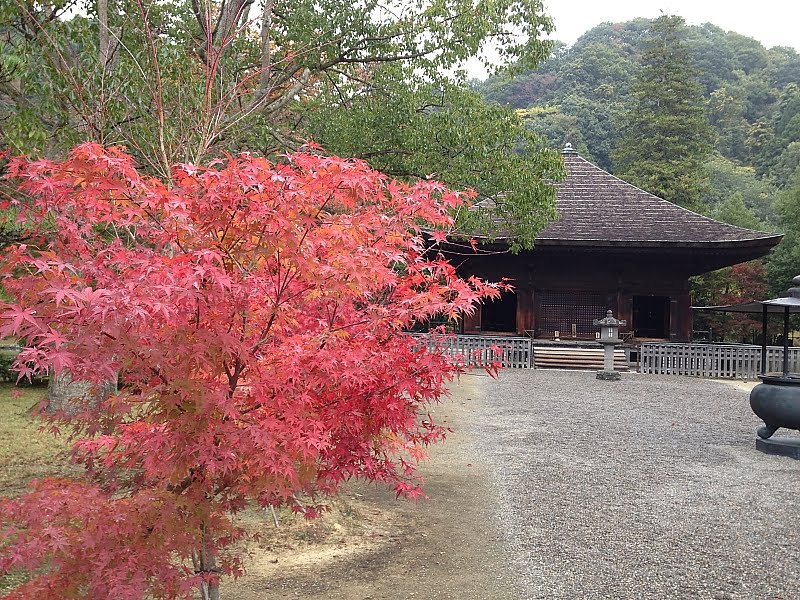
After driving along the coastal area, we went back inland area and visited a temple. It was designed in the image of buddhist heaven and was established in 1160.
A Calm place. It was hard to understand that this garden and the wrecked coast were in the same city.
After this trip, I asked my friend what I can do for Fukushima people from far distant area except donation and purchasing Fukushima products. His answer was "remember them and this experience". At first, I follow the Twitter List whose member are the people in charge of reconstruction Fukushima. I read their tweets everyday. It is the first step for me. I'm thinking about the next step now.
The first day - visiting facilities to promote the safety of nuclear plants
On the 5th of November, after a 6-hour train trip that was over 6 hours lomg, I met him in his home town. He drove me in his car to Tokai nuclear plant. It is not a Fukushima plant, and was not damaged by the tsunami, but it was the first nuclear plant in Japan. We visited two well-equipped facilities within a 10-minute-drive from each other. Both of them promoted safety and importance of nuclear power generation and plants, even to kids with some interactive attractions designed to learn about atomic power.
I don't have deep knowledge about them. But I realized one thing clearly -Nuclear power generation companies and electric power companies pay a lot of money for these facilities. They have strong reasons to do so.
I took all available brochures and textbooks from them. I'm going to read them to learn more about their story.
The second day - visiting an area which has been affected not only by the Tsunami but also by radioactivity
On the 6th of November, we went to Iwaki city, which is located in the south end of Fukushima prefecture. The distance from the damaged nuclear plants to the city is within 50km(30miles). The amount of radioactivity in the air (1m from the ground) is 0.2-0.5mSv of radiation, which is not large enough to have an affect on the human body. It is one one-hundredth the amount of radioactivity present at the edge of the restricted area, 30km/19miles radius of the damaged Fukushima plant. But some people, in particular parents who have small children, are nervous about the condition because it is double that of other normal areas.
Anyway, whenever people around the world hear the name "Fukushima", they generally think about the radioactivity, rather than the damage by the quake or tsunami. It may be a "natural" reaction these days. It is the same in Japan. However, I realized that this way of thinking is not entirely accurate.
It took about an hour to go from my friends town to Iwaki by car on the express way. He has a pass to go on the expressway without any fee, because the ceiling of his house was damaged by the quake (he and all his family were not injured).
Approaching Iwaki, the road condition gradually worse -like the shape of a wave. It is the result of the earth quake power. Except for that, the downtown of Iwaki (an inland area) looks very normal.
Was this a railway station in the disaster area?
When we went to the coast area, the landscape suddenly changed.
A damaged Seven-Eleven convenience store. The store remains open -selling things out of a store vehicle.
Leveled housing lots. Eight months ago, there were many houses here but they were washed away by the tsunami.
Rubble of destroyed of houses were gathered here at the former location of a school by volunteers.
The seashore was washed away, so there is a temporary embankment.
This grocery store suffered a lot of damage, but...
It is actually still opens for business!
Messages of encouragement from people to the shop.
I was surprised by the cheerfulness of the shop clerks... They worked with smiles and cheerful voices.
The harbor which is located at the back of the shop.
A flower in the rubble wilderness. It is the "work" of the artists of the project called "Let's make flowers bloom in the rubble field." They paint flowers on the walls of the wrecked houses which the municipal government has decided to tear down, to change the devastated landscape.
Flowers on the wall
After driving along the coastal area, we went back inland area and visited a temple. It was designed in the image of buddhist heaven and was established in 1160.
A Calm place. It was hard to understand that this garden and the wrecked coast were in the same city.
After this trip, I asked my friend what I can do for Fukushima people from far distant area except donation and purchasing Fukushima products. His answer was "remember them and this experience". At first, I follow the Twitter List whose member are the people in charge of reconstruction Fukushima. I read their tweets everyday. It is the first step for me. I'm thinking about the next step now.
Sunday, October 30, 2011
iPhone4S Siri vs Me
I purchase my new iPhone(4S) and enjoy it, in particular, Siri(voice control personal assistant).
But my poor English confuses her.
These are my results:
Me "What is the weather of today?"
Siri "What is WeDah?"
My second try - Success
"Search for Paul McCartney"
"Such for Paul McCartney - Sorry, I don't understand"
I tried five times but failed...
"Tell me about Paul McCartney" - success
"Where is Nishinomiya(my hometown)?"
"You are always there and I'm here."(I forget Siri's exact sentences)
"Show me the way to Tokyo"
"Sorry, I cannot provide maps and direction services in Japan"
"Which do you like iPhone or Android?"
"I don't understand [Do you right]"
"Which do you like iPhone or Android?"
"It's on you, not me."
"You are excellent"
"I don't like such arbitrary sentence."
"Who are you?"
"I don't know. If you go Genius Bar you may know that."
"Sing Daisy" *cf. the movie"2001:A Space Odyssey"
I tried several times but failed.
ex. "Seeing Daisy","Think Baby", or something.
"Sing a song Daisy"
"I don't understand "Sing-a-song Daisy"
She is one of my teacher of English conversations.
But my poor English confuses her.
These are my results:
Me "What is the weather of today?"
Siri "What is WeDah?"
My second try - Success
"Search for Paul McCartney"
"Such for Paul McCartney - Sorry, I don't understand"
I tried five times but failed...
"Tell me about Paul McCartney" - success
"Where is Nishinomiya(my hometown)?"
"You are always there and I'm here."(I forget Siri's exact sentences)
"Show me the way to Tokyo"
"Sorry, I cannot provide maps and direction services in Japan"
"Which do you like iPhone or Android?"
"I don't understand [Do you right]"
"Which do you like iPhone or Android?"
"It's on you, not me."
"You are excellent"
"I don't like such arbitrary sentence."
"Who are you?"
"I don't know. If you go Genius Bar you may know that."
"Sing Daisy" *cf. the movie"2001:A Space Odyssey"
I tried several times but failed.
ex. "Seeing Daisy","Think Baby", or something.
"Sing a song Daisy"
"I don't understand "Sing-a-song Daisy"
She is one of my teacher of English conversations.
Tuesday, July 26, 2011
If a cover band of the Beatles in 2010 time-slipped to the world of 1961...
If a cover band of the Beatles in 2010 time-slipped to the world of 1961 (one year before the Beatles debut), this may be what would have happened... This is the story of a controversial manga "I am The Beatles" ("Boku wa Beatles") by Tetsuo Fujii & Kaiji Kawaguchi
In Tokyo in 2010, the Fab Four, a popular Beatles cover band, faced a crisis which threatened to disband them due to conflicting future aspirations among the band members. Rei, on the part of John Lennon, Makoto (Paul McCartney) and Show (George Harrison), quarreled with each other and fell to a subway platform. Konta (Ringo Starr) also fainted with them. When they woke up, they were in 1961 Tokyo.
Makoto made a plan as follows; To play the Beatles' songs as if they were the Fab Four's originals in 1961, before the original Beatles' debut. The idea was that the Beatles would listen to them and then they would make greater songs. Show was hesitant at first but was persuaded by Makoto. They were discovered by a competent female manager like Brian Epstein and released the first single "I Want to Hold Your Hand". When they released their second single, Konta joined the Fab Four. Rei didn't join them because he thought what they were doing was blasphemy to the Beatles.
As they became popular, their manager sent their singles to a UK music producer. Their songs were played on air in the UK. After that, the manager went on a business trip to London for a contract to release records of the Fab Four. Having been asked by Makoto, she went to Liverpool and contacted fans of the Beatles. They told her that the Beatles had stopped singing their songs from the last month because "something shocking had happened," the Fab Four's songs began to play on air from that last month.
All members of the Fab Four were shocked very much and they became conscious of their obligation -to introduce the Beatles songs to the world. (to be continued)
My comment: This is a controversial manga among Japanese beatlemaniacs. Some fans admired the authors' unique idea and detailed description based on abundant data. Other fans think this work is blasphemy to the Beatles.
Some fans, myself included, feel this work is interesting, in particular, for taking up the theme of "a copier's identity". Rei said to Makoto, "When we copy the Beatles perfectly, even their misplaying, we are standing on the furthest point from the Beatles."
All creators might begin their career from copying their favorite artists and gradually adding their originality. But a cover band's aim is to copy other artists perfectly, not to make originality. The audience wants them to do so. Therefore, what is a cover band's identity?
I'm looking forward to what the conclusion of the theme of this work will be.
Subscribe to:
Posts (Atom)