1. Johann Sebastian Bach
2. The Beatles
3. Paul McCartney
4. Ryuichi Sakamoto
5. Brian Wilson
6. Vampire Weekend
7. Muse
8. Kinoco Hotel
9. Gilbert O'Sullivan
10. L<->R
This year's new artists for me are 6,7 and 8.
Friday, December 31, 2010

Wednesday, November 17, 2010
Foreigners' Questions about Japan (3) Why is working long hours, with little vacation time, so important in Japan?
At first, I want to tell you that Japanese hate to work long hours. We like holidays and envy long vacations among many European workers.
However, Japanese workers can take only 5.1 days on average for summer holidays including Saturday and Sunday. Companies give 18 holidays per year but workers take only 8.5 days on average. Why do we work long hours and take short holidays?
I think the reason why is depending on two points as follows:
(1)Companies and workers fear losing jobs
If your client asks your company, "Can you finish this 48-hour job within these two days?", what does your company reply? Maybe all foreign companies don't accept this offer because it is impossible. But some Japanese companies will accept it. For them, it isn't an impossible order – if workers don't take a rest throughout the 48 hours. Such Japanese companies and workers think such work is convinient to their clients, and they try to avoid losing this precious work. If they refuse it, the work will be simply brought to another company which can accept it. And such companies are not rare in Japan.
(2)Mature people should bear hard situations and never complain about them.
If your daughter or son in kindergarten screams "I wanna eat something!" on a train, you say to her or him, "Hold on". Self-control is an expectation for mature people.
Japanese tend to adapt this expectation to the workplace. Refraining from taking holidays and to leaving your office on time are required for you as a mature people. They think that a person who says "I wanna take long holidays" is a child.
Of course, many Japanese workers think that this is an absurd notion. But unfortunately, most people are afraid of their co-workers or bosses thinking they are like children. Conformity is an essential element of our community. So people have a tendency not to take long holidays.
Other reasons: see my past entry "Why do Japanese businesspeople work till late?"
However, Japanese workers can take only 5.1 days on average for summer holidays including Saturday and Sunday. Companies give 18 holidays per year but workers take only 8.5 days on average. Why do we work long hours and take short holidays?
I think the reason why is depending on two points as follows:
(1)Companies and workers fear losing jobs
If your client asks your company, "Can you finish this 48-hour job within these two days?", what does your company reply? Maybe all foreign companies don't accept this offer because it is impossible. But some Japanese companies will accept it. For them, it isn't an impossible order – if workers don't take a rest throughout the 48 hours. Such Japanese companies and workers think such work is convinient to their clients, and they try to avoid losing this precious work. If they refuse it, the work will be simply brought to another company which can accept it. And such companies are not rare in Japan.
(2)Mature people should bear hard situations and never complain about them.
If your daughter or son in kindergarten screams "I wanna eat something!" on a train, you say to her or him, "Hold on". Self-control is an expectation for mature people.
Japanese tend to adapt this expectation to the workplace. Refraining from taking holidays and to leaving your office on time are required for you as a mature people. They think that a person who says "I wanna take long holidays" is a child.
Of course, many Japanese workers think that this is an absurd notion. But unfortunately, most people are afraid of their co-workers or bosses thinking they are like children. Conformity is an essential element of our community. So people have a tendency not to take long holidays.
Other reasons: see my past entry "Why do Japanese businesspeople work till late?"
Sunday, October 03, 2010
Foreigners' Questions about Japan (2) What is your favorite thing about Japan/Japanese culture?
I don't hesitate to admire social safety in Japan. According to OECD Factbook, Japan's victimization rates (Percentage, one year prevalence victimization except murder rates among the entire population) is the second lowest in all OECD countries. Rates in 2005: Spain 9.1, Japan 9.9, France 12, OECD average 14.5, US 17.5, and UK 21.
http://puck.sourceoecd.org/vl=19842971/cl=16/nw=1/rpsv/factbook2009/11/04/01/index.htm
As for murder rate among 150 WHO member countries, Japan is the second lowest.
Last year, I dropped my wallet which contains $700 / 530Euro / 475pounds at Tokyo. Three days later, my wallet was sent to my home in the same condition as when I dropped them. It was lucky case, but not rare in Japan.
Cleanliness and hygiene mind and punctual customer services (for instance, railways) in Japan make me feel comfortable.
I like some modern culture of Japan, but most of them are affected by western culture. But graphic novel, a.k.a manga is one of Japan-established culture which may be easy to be understood by worldwide people. I also like Japanese traditional culture – cooking, arts and architectures (for example, Buddha statues and temples) – but I think that some of them aren't easy to be understood for some westerners except as for orientarism-understanding.
Japanese people are tolerant for religions. The same person is celebrated by Shinto way, which is Japanese original religion, when after one month later he / she was born, He / she marries in Christian style – even though they never read the holy bible, and his / her funeral is conducted according to Buddhism rites. Many foreign people, in particular monotheism believers, may feel it ridiculous. But I think it was a good side of Japanese culture. Many Japanese seem to think that religious intolerance is an origin of serious conflicts, and I also agree with it.
For reference: newspaper findings
What characteristic of Japan do Japanese like best?
Safety, beautiful four seasons, diligence, delicious foods, glorious nature, moralistic mind, heritage, peace-oriented mind, non-class-based society, comfortable climate, cooperativeness
What characteristic of Japan don't Japanese like?
Closed-society, group mentality, intolerance, political system, opportunism, lack of creativity, irresponsiblility, indifference for others, homogeneous society, history during era of imperialism.
http://puck.sourceoecd.org/vl=19842971/cl=16/nw=1/rpsv/factbook2009/11/04/01/index.htm
As for murder rate among 150 WHO member countries, Japan is the second lowest.
Last year, I dropped my wallet which contains $700 / 530Euro / 475pounds at Tokyo. Three days later, my wallet was sent to my home in the same condition as when I dropped them. It was lucky case, but not rare in Japan.
Cleanliness and hygiene mind and punctual customer services (for instance, railways) in Japan make me feel comfortable.
I like some modern culture of Japan, but most of them are affected by western culture. But graphic novel, a.k.a manga is one of Japan-established culture which may be easy to be understood by worldwide people. I also like Japanese traditional culture – cooking, arts and architectures (for example, Buddha statues and temples) – but I think that some of them aren't easy to be understood for some westerners except as for orientarism-understanding.
Japanese people are tolerant for religions. The same person is celebrated by Shinto way, which is Japanese original religion, when after one month later he / she was born, He / she marries in Christian style – even though they never read the holy bible, and his / her funeral is conducted according to Buddhism rites. Many foreign people, in particular monotheism believers, may feel it ridiculous. But I think it was a good side of Japanese culture. Many Japanese seem to think that religious intolerance is an origin of serious conflicts, and I also agree with it.
For reference: newspaper findings
What characteristic of Japan do Japanese like best?
Safety, beautiful four seasons, diligence, delicious foods, glorious nature, moralistic mind, heritage, peace-oriented mind, non-class-based society, comfortable climate, cooperativeness
What characteristic of Japan don't Japanese like?
Closed-society, group mentality, intolerance, political system, opportunism, lack of creativity, irresponsiblility, indifference for others, homogeneous society, history during era of imperialism.
Sunday, July 11, 2010
Foreigners' Questions about Japan (1) What do you think is the most misunderstood aspect of modern Japan?
Male chauvinism. When I told westerners that my wife was housewife, some of them thought that I forced my wife to quit her work. It wasn't true, quitting her job depended on her own will and a condition (our new house was far from her office.) I admit that male chauvinism still remain in Japan, in particular many elderly people and some younger people. But times are changing. Japan is behind western people about gender equality, however, it's getting to improve.
Saturday, July 03, 2010
A trip to meet two heroes for Japanese (2)
My family and I parted in the meantime. I went to Kouchi city to see a exhibition and museum of Ryoma Sakamoto, who is a hero among many Japanese.
He was a swordmaster, an entrepreneur, and a peacemaker in the last part of the Samurai era (1860s). Japanese think that he is one of the most important people of Japanese modernization.

What did he do? The Sakamoto Ryoma Memorial Museum said as follows:
In short, Ryoma was a man who triggered the collapse of Shogun's feudal government. In the 1860s, the government had no power to refuse western nations' requests (for example, trading on unequal treaty) and lost power to control regional feudal lords. Some people thought that the government couldn't defend Japan from western nations, and therefore supported the overthrow the government and establishment of a new unified nation under the Emperor. He was one of those man.
Ryoma succeeded to make partnership between two powerful feudal groups even though they were opposing. Both groups thought to overthrow the government by force, but Ryoma thought to avoid civil war. So he proposed to a lord a plan in which the government returned political power to the Emperor. The lord proposed the plan and the government accepted it. In addition, Ryoma wrote the way of new government: establishing the parliament, new law system and modern navy, trading other nations on equal treaty (the old government shut down trade with any nations except China, Korea and the Netherlands for over 200 years.), etc.
His action and plans affected new Japanese modern government strongly. He was assassinated by an unknown person in December of 1867. The new government was established in 1868.
He is very popular among Japanese of all ages, especially this year. Because one of the most popular TV drama series this year picks up Ryoma as a main character. So there is a temporary exhibition displayed in front of Kouchi station.

Right: Ryoma. Left: Iwasaki, the founder of Mitsubishi. Iwasaki was a friend of Ryoma. Both of two were born in this prefecture, lower-class samurai. In particular, Iwasaki was very poor.

The Sakamoto Ryoma Memorial Museum. It exhibits Ryoma's career, background and his letters.
My opinion about Ryoma is simple: If he didn't exist, there is a possibility that Japan would have failed to modernize peacefully, otherwise terrorism could have happened. Like many other Japanese, I also think he was great.
He was a swordmaster, an entrepreneur, and a peacemaker in the last part of the Samurai era (1860s). Japanese think that he is one of the most important people of Japanese modernization.

What did he do? The Sakamoto Ryoma Memorial Museum said as follows:
In short, Ryoma was a man who triggered the collapse of Shogun's feudal government. In the 1860s, the government had no power to refuse western nations' requests (for example, trading on unequal treaty) and lost power to control regional feudal lords. Some people thought that the government couldn't defend Japan from western nations, and therefore supported the overthrow the government and establishment of a new unified nation under the Emperor. He was one of those man.
Ryoma succeeded to make partnership between two powerful feudal groups even though they were opposing. Both groups thought to overthrow the government by force, but Ryoma thought to avoid civil war. So he proposed to a lord a plan in which the government returned political power to the Emperor. The lord proposed the plan and the government accepted it. In addition, Ryoma wrote the way of new government: establishing the parliament, new law system and modern navy, trading other nations on equal treaty (the old government shut down trade with any nations except China, Korea and the Netherlands for over 200 years.), etc.
His action and plans affected new Japanese modern government strongly. He was assassinated by an unknown person in December of 1867. The new government was established in 1868.
He is very popular among Japanese of all ages, especially this year. Because one of the most popular TV drama series this year picks up Ryoma as a main character. So there is a temporary exhibition displayed in front of Kouchi station.

Right: Ryoma. Left: Iwasaki, the founder of Mitsubishi. Iwasaki was a friend of Ryoma. Both of two were born in this prefecture, lower-class samurai. In particular, Iwasaki was very poor.

The Sakamoto Ryoma Memorial Museum. It exhibits Ryoma's career, background and his letters.
My opinion about Ryoma is simple: If he didn't exist, there is a possibility that Japan would have failed to modernize peacefully, otherwise terrorism could have happened. Like many other Japanese, I also think he was great.
Saturday, May 08, 2010
A trip to meet two heroes for Japanese (1)
My wife, three-year-old son, and I took a trip to meet a hero. Who was he? He was Anpanman, the most popular hero among Japanese pre-kindergarten kids.
Anpanman is a justice friend wearing a cape and flying in the sky like Superman. His item to help people is his face – it is made of bread! When he finds a starving person, he cuts off a part of his own face and gives it to him/her.. "Anpan" means bread with "an" which is Japanese bean jam.
The history of national star of Anpanman is very long. He was born as a picture book character in 1973. At first, it was popular among a group of kids. In 1988, this character was animated for a TV program, then he became a popular nationwide hero for kids. On the TV program, the original story was changed. It didn't include starving people but many characters based on meals. For example, a banana, pizza and a donut... Guinness book of world records admitted this program for the world's highest character count animation – 1,738. Of course now Anpanman is broadcasted all over Japan every Sunday morning.
Like other kids, my son likes him (his first word was "Anpanman") so my wife planned a trip to Anpanman sanctuary. It is the birthplace of the author of Anpanman where the Anpanman Museum was built.
We reserved the "Anpanman-train". Its walls, ceiling and seats are printed with Anpanman characters.


It took two and half hours by this train and 30 minutes by Ampanman bus to go to the Museum (the author's birthplace is rural).


The museum (left) and a hotel.

This hotel is fully furnished in Anpanman!

A settlement near the Museum also features Anpanman characters.
(Taking pictures of the Museum is allowed but posting them on blogs is prohibited.)
My son seemed very excited and satisfied by this hotel and museum. It was what my wife and I wanted.
(to be continued: the next entry will be about a hero of most Japanese adults.)
Anpanman is a justice friend wearing a cape and flying in the sky like Superman. His item to help people is his face – it is made of bread! When he finds a starving person, he cuts off a part of his own face and gives it to him/her.. "Anpan" means bread with "an" which is Japanese bean jam.
The history of national star of Anpanman is very long. He was born as a picture book character in 1973. At first, it was popular among a group of kids. In 1988, this character was animated for a TV program, then he became a popular nationwide hero for kids. On the TV program, the original story was changed. It didn't include starving people but many characters based on meals. For example, a banana, pizza and a donut... Guinness book of world records admitted this program for the world's highest character count animation – 1,738. Of course now Anpanman is broadcasted all over Japan every Sunday morning.
Like other kids, my son likes him (his first word was "Anpanman") so my wife planned a trip to Anpanman sanctuary. It is the birthplace of the author of Anpanman where the Anpanman Museum was built.
We reserved the "Anpanman-train". Its walls, ceiling and seats are printed with Anpanman characters.


It took two and half hours by this train and 30 minutes by Ampanman bus to go to the Museum (the author's birthplace is rural).


The museum (left) and a hotel.

This hotel is fully furnished in Anpanman!
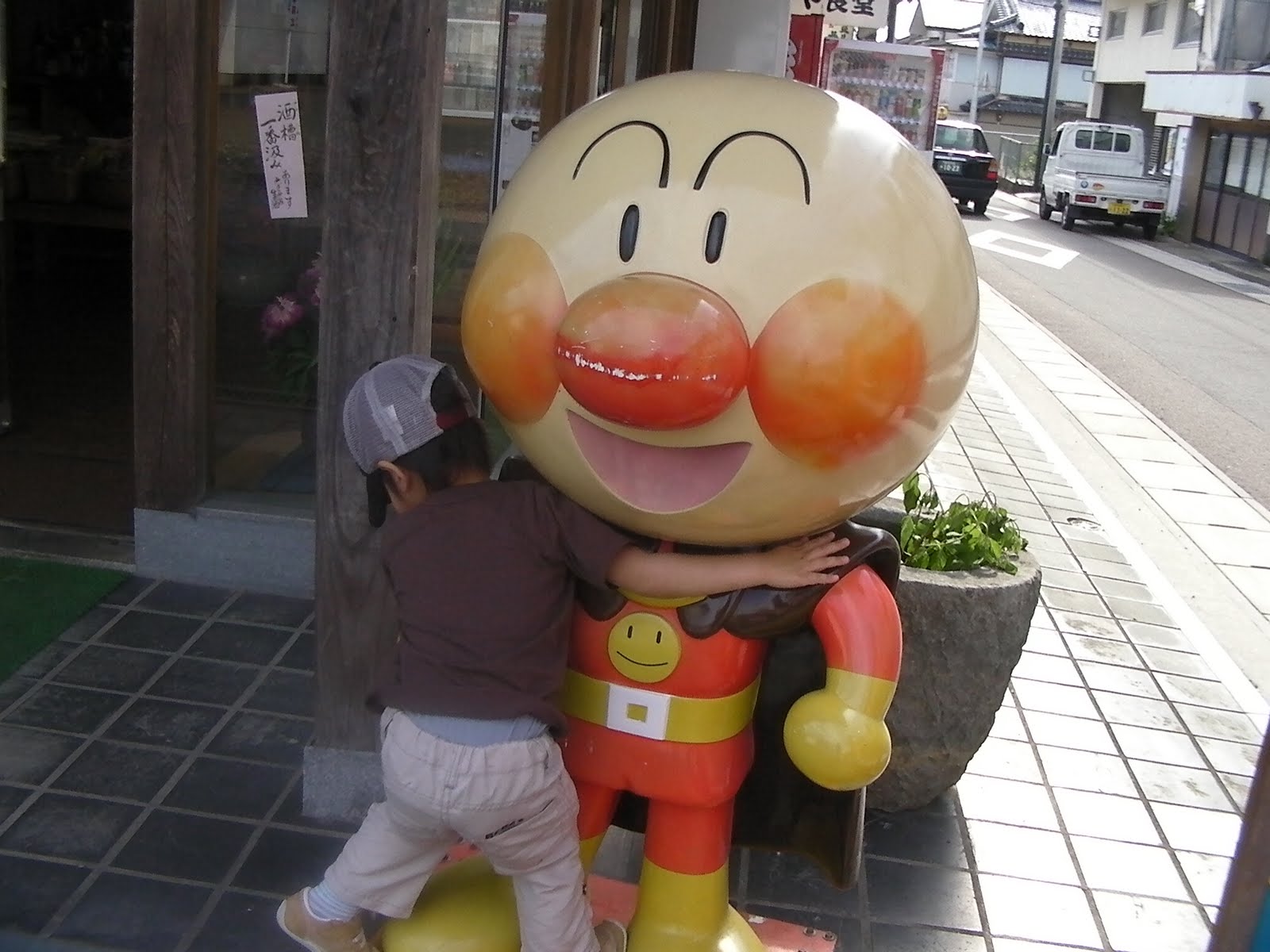
A settlement near the Museum also features Anpanman characters.
(Taking pictures of the Museum is allowed but posting them on blogs is prohibited.)
My son seemed very excited and satisfied by this hotel and museum. It was what my wife and I wanted.
(to be continued: the next entry will be about a hero of most Japanese adults.)
Wednesday, May 05, 2010
F. Scott Fitzgerald "Great Gatsby"
(This entry was written in 2006, soon after Haruki Murakami's Japanese translation was released.)
[Story]
In 1922, 30-year-old Nick moved to New York. He spent his life frugally, but lived in an area of many mansions. In such an area, Gatsby, who lived next door to Nick, had especially large land and a splendid house. Nick attended his party to know the mysterious neighborhood...
[My opinion]
This is a new Japanese translation by Haruki Murakami. With Murakami's many praises to this novel, I had been looking forward to reading it. In conclusion, this novel certainly met my great expectations.
The Japanese publisher of this new translation labeled this copy "a sorrowful and noble story". Such words fit this work more than other novels, I think. The vanity of luxurious parties, love affairs among men and women, unmeasured indiscretion of people who have power, sudden tragedy and Gatsby's rarefied will and behavior of his will – these factors were described by very classical sentences. This "classical" means high quality, neat and having value that may not be lost overtime. I think it depends on Fitzgerald's original sentences but also Haruki Murakami's spirited translation.
After a long interval, I encountered an overseas novel which I now want to read many times. The intrinsic value and power of this story are deserving.
After reading, I saw the book cover of this novel and felt very sad, even though I never gave heed to it before reading. It is merely a picture of a withered leaf floating in water. This difference of feeling may show the power of this novel.
[Story]
In 1922, 30-year-old Nick moved to New York. He spent his life frugally, but lived in an area of many mansions. In such an area, Gatsby, who lived next door to Nick, had especially large land and a splendid house. Nick attended his party to know the mysterious neighborhood...
[My opinion]
This is a new Japanese translation by Haruki Murakami. With Murakami's many praises to this novel, I had been looking forward to reading it. In conclusion, this novel certainly met my great expectations.
The Japanese publisher of this new translation labeled this copy "a sorrowful and noble story". Such words fit this work more than other novels, I think. The vanity of luxurious parties, love affairs among men and women, unmeasured indiscretion of people who have power, sudden tragedy and Gatsby's rarefied will and behavior of his will – these factors were described by very classical sentences. This "classical" means high quality, neat and having value that may not be lost overtime. I think it depends on Fitzgerald's original sentences but also Haruki Murakami's spirited translation.
After a long interval, I encountered an overseas novel which I now want to read many times. The intrinsic value and power of this story are deserving.
After reading, I saw the book cover of this novel and felt very sad, even though I never gave heed to it before reading. It is merely a picture of a withered leaf floating in water. This difference of feeling may show the power of this novel.
Subscribe to:
Posts (Atom)